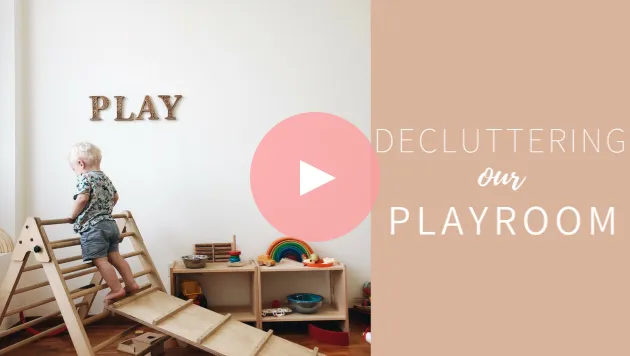
I’m a big believer that less is more when it comes to toys. Not only do I see it again and again how much better my children play when I declutter their playspace, research also shows that having fewer toys supports creativity, helps children focus for longer during play.
I love setting up playspaces that encourage creativity and engaged play. And after spending a lot of time observing my kids playing and trying out different setups for them I’ve realised that you only need about 8-10 types of toys to set up a perfectly completed, magical, play environment for your kids.
Here are the only 10 types of toys needed for rich, creative play:
- Blocks
This category spans anything to build with. Most homes already have some type of blocks in their playroom already and any set of blocks will basically do: Classic wooden blocks are great, duplo or classic lego works perfectly as well. We love our nature blocks and also love our Just Blocks wooden blocks for an extra layer of building options. - Alternative blocks
Open ended toys have endless possibilities and blocks are probably one of the most open ended play materials you can find. That’s why I recommend providing another type of blocks to extend the possibilities of creation even further.
I would highly recommend getting magnetic tiles to fill this “Alternative blocks” category, MagnaTiles being our personal favourite (and basically an all time favourite play material in my house). - People/Figures/Characters
After your child has used blocks and other materials to built their world, they will need characters or figures to interact with that world.
This category should be quite easy to fill with something your child owns already. Playmobil characters are very popular in my house, as well as our PlanToys family. Wooden peg dolls are also great or a collection of duplo characters. - Animals
With the same purpose as Characters, animals will bring your child’s creation to life. We love our Schleich animals, any types of plastic animals will work here, or beautiful wooden animals like Holtztiger. Duplo or Playmobil animals also work great if you already have those in your home. - Vehicles
Cars, trains, trucks… plastic or wooden, anything on wheels can fit this category! - Roads
…To go with the vehicles! To be honest I have gone a little bit back and forth on this category, not sure if I should include roads or not. Out of all the categories listed I would say this one could be prioritised last in the row. But with that said, a set of train tracks or rubber roads (we have the ones from WayToPlay) are without a doubt a great addition to any playspace and will make for a more “completed” and harmonious collection of materials. - Stuffed animals and dolls
I always put stuffed animals and dolls together in one category because they play a very similar role for the child. Children like to play in a nurturing way with both; roleplaying caregiving activities and cuddling them. Although stuffed animals and dolls are great play materials, they tend to flood the playroom (stuffed animals in particular). My golden rule on stuffed animals is to try and minimise them to only 10 max.
You can rotate them if you want of course. But try not to keep too many out at once, too many will only makes for a messier playspace which results in less focused play! - Play silks/fabrics and “binding material”
Open ended materials to “join together” and enrich their creation.
Fabrics / play silks (Sarah’s Silks being our favourite) are a wonderful addition to any playspace. They can use blue silk for their water, green fabric for grass, silks and fabrics are perfect for fort making, dress up play, for play with dolls and stuffed animals, etc. fabrics are super open ended and have endless possibilities.
Other materials I like to provide that fit in this category is for example a basic string (to use to tie up and create things) and felt. - Decoration/Magic
This category is for materials children will use to decorate their creations and bring depth and detail to their play scenes. This could be sea shells, rocks, pebbles, crystals, acrylic jewels, or decorative glass pebbles! Also, anything from nature are perfect for this category; like acorns, feathers or leaves. - You choose!
This category is an empty slot for you to fill with whatever toys / material your child loves and you think fits will with the categories of toys I’ve already listed. For me, this category would be filled with our Grimms rainbow for example.
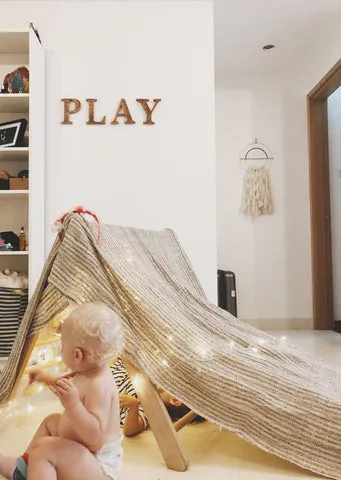
What does a playspace with only 10 types of toys look like?
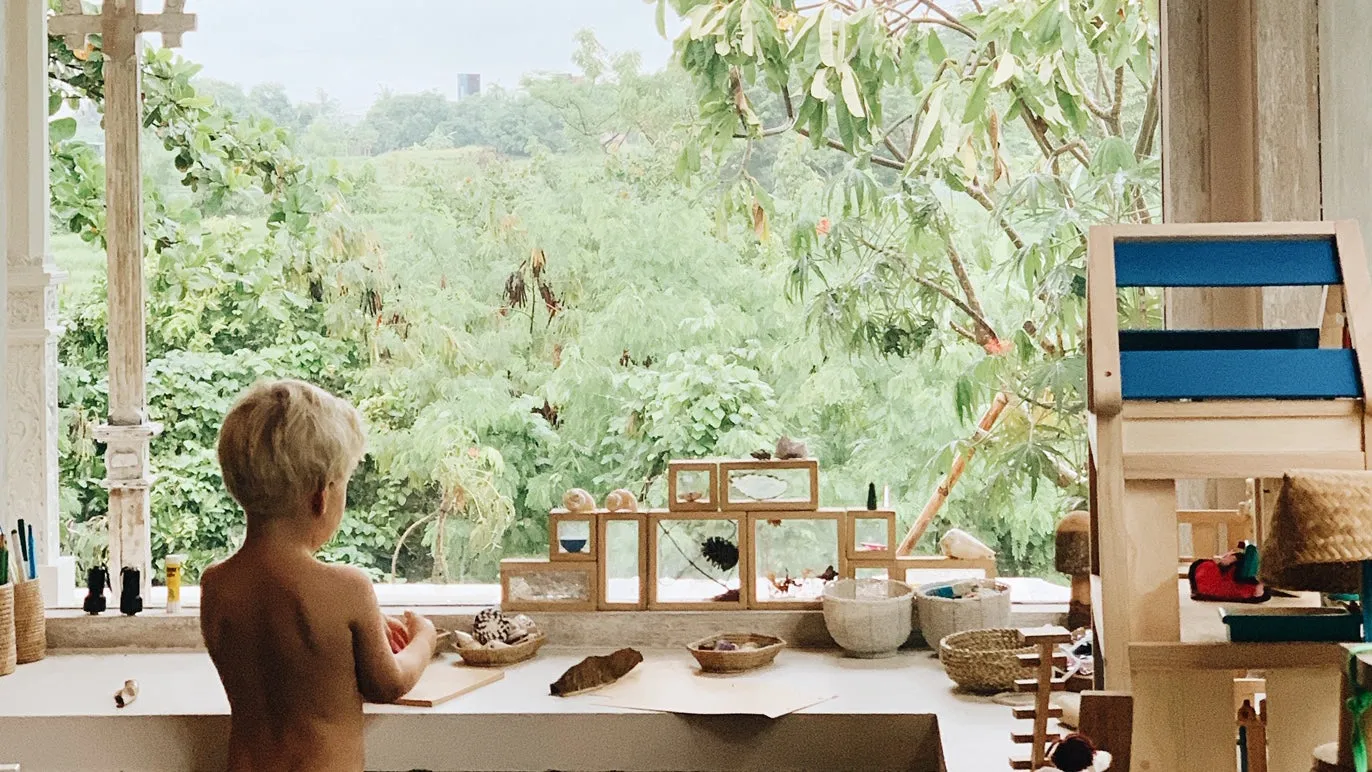
Following are pictures of my kids playing in a play-space setup with ONLY these 10 types of toys. Just to give you guys an idea how rich a minimal setup like this actually is. These were literally the only toys my kids had got to play with for 9 months straight while we were in the process of moving to Bali.
A playspace with only these 10 types of toys, served my two children perfectly for all this time.
- Playsilk,
- Just Blocks,
- Way to Play rubber road
- Nature blocks
- A soft basket with playmobil characters
- Decorating with our sea shells
- Magnatiles
Simple, yet so rich
How I set up the playspace
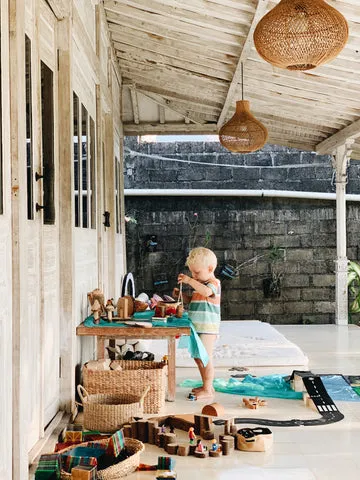
When setting up the playspace try going for a well organised, minimalist setup in a part of your home where there is good, peaceful energy. Good floor space and natural light is a big bonus.
I always recommend keeping each category of toys in an open basket or tray on low shelves where the child can both see and access the material easily.
Open baskets for easy access
The “10 toys list” is meant to be a guideline for a playspace setup
Finally, it’s important that I mention that arts and crafts materials, play dough and other sensory materials are not included in this list because that is a different kind of play activity. They are not generally a part of my children’s main playspace setup. I normally keep arts and crafts materials in our craft closet and will bring them out for when we do craft activities.
This also goes for books, puzzles, board games, activity books etc. which I also don’t included these categories in the “10 toys” list since yes, they might be a part of my child’s bedroom setup but books or puzzles serve a different play purpose that the materials listed above.
At different ages
- The first months
During the first few months, toys are simply unnecessary. Magda Gerber saw the hands of the newborn as the first toy, and children spend a lot of time investigating these little miracles. The next toy is simply the whole universe around them, and the different objects and textures they find in their environment. Cloth, silk scarves, silicone cupcake moulds, light-weight measuring spoons, little cups from thin steel and a soft ball are all very convenient objects to offer.
- Reaching and grasping
In the second or third month, we start to place carefully selected toys around the child while they lie on their back in a safe space. We never place a toy in their hands. This way we can be sure that they grab the one they are genuinely interested in.
Light things that are easy to grab work best: cloth, silk, silicone cupcake moulds, teething rings, light measuring spoons. A little later the kitchen cupboard becomes our best friend, with its steel bowls, strainers and spatulas.
- Crawling and walking
A whole new world opens up when a child begins to crawl. Balls and other things that roll are especially relevant now, because a child can crawl after something that is rolling away.
A walking child becomes very quickly interested in lifting and holding objects, collecting toys in small bags, moving things between containers, and dragging things around. Building blocks start to play an important role.
Questions parents ask
How many toys does a child really need?
You only need about 8-10 types of toys to set up a complete, magical play environment. A playspace with only these ten types of toys served my two children perfectly for nine months straight.
What toys do kids actually play with?
If there is any one toy I always recommend it's getting magnetic tiles, there are a few brands out there and our personal favourite is MagnaTiles or Connetix Tiles. Magnetic blocks are so versatile and definitely an all time favourite play material in my house!
Are fewer toys better for children?
I see it again and again how much better my children play when I declutter their playspace. Research also shows that having fewer toys supports creativity and helps children focus for longer during play.
What about books, puzzles and craft materials?
They are not part of the list, because that is a different kind of play activity. I keep arts and crafts materials in our craft closet and bring them out when we do craft activities. Books and puzzles might be part of my child’s bedroom setup, but they serve a different play purpose.
I hope this was helpful to you guys! I would love to follow you on your re-organising or decluttering journey, if you decide to use any of my suggestions for your child’s playspace please share a photo or video of your process or end results on IG and tag (@respectfulmom) for me to see!
Love!
Kristin Mariella