Being a calm and collected parent, rising above the tension, being the graceful, confident, mature leader that our children need: this is the parent most of us aspire to be, desire, and even promise ourselves we’re going to be, but it can be difficult to sustain!
We know how important it is to parent from a place of love rather than from fear, but despite our best intentions we lose it and end up yelling at those we love the most — our kids.
But why do parents yell?
The way I see it, it is usually a mix of mindset and triggers. When it comes to mindset the way we see our children and their behaviour has great effect on how we react to them. For example what we expect of them in each situation; Do we expect them to listen and obey our words? Or are we ready to understand that they might need more help from us than just our vocal direction? Do we see our children’s misbehaviour as them “giving us a hard time” instead of them “having a hard time”? Do we view our children as “naughty” or “bad,” or do we see them as inherently good, always trying the best they can in each situation?
“These mindset shifts have drastic effect on how we react to our children when things get tough. So when it comes to it, much of is it actually about reframing and educating ourselves on what behaviour really is.”
The other reason we might find ourselves yelling at our kids is our own triggers. We often blame our kids for our outbursts and convince ourselves that it’s because they don’t listen, are disrespectful, sassy, or misbehave. But it’s important to understand that these are our own triggers at play. Our children’s actions, behaviour or events can push our buttons, bring up pain, unresolved trauma or other memories from our own childhood and that will often make us react without thinking, in ways we usually regret later!
But raising our voices rarely solves the situation. It may make our children obey us for a short while, but it won’t make them learn in the long run. Recent research points out that yelling actually brings out more aggression in children, both physically and verbally. To me, though, the most real proof of why we shouldn’t be yelling at our kids is that we feel terrible afterwards. No one ever said “Oh that was a great idea, I feel so much better now!” after blowing up and yelling at their children. No, instead we feel guilty and usually want to apologise (which is a great idea, by the way).
What leads to yelling
When I look at what comes before the yell, it’s usually one of these five:
- Feeling overwhelmed, rushed and in chaos
- Waiting too long to set the limit
- Relying on your words instead of following through physically
- Not enough self care
- The bitter running commentary in your head when you are overtired
See, when we are on the edge it’s really easy to be pushed over.
So how to turn around the pattern of yelling?
- It always starts and ends with us.
As a parent I believe it is our #1 job to keep ourselves emotionally healthy (via self-care, mindfulness practices or other means) so we can actually show up as the parent we want to be for our children. It’s truly impossible to consistently be emotionally generous to our children when we are a dry sponge to ourselves. See, when we are on the edge it’s really easy to be pushed over. It’s our responsibility to stay away from the edge in the first place! - Don’t correct until you connect.
In any stressful situation try coming from a place of deep empathy and practice seeing things from your child’s perspective. When we truly acknowledge feelings (all feelings!) from a place of empathy, there will be no room for anger. And when our children feel we are on their side and understand, even when we are setting necessary limits, they want to behave and cooperate. This is why empathic limits are so powerful because we connect while setting limits. - Instead of yelling, MODEL.
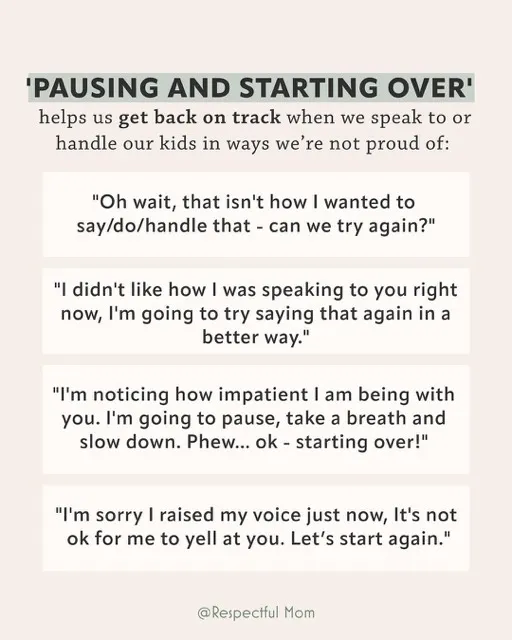
Modelling what we want to see in our children is the single most powerful thing we can do as parents. If we want to see emotional regulation, we need to show emotional regulation. It is actually a golden opportunity when we are JUST ABOUT to lose it (or we just lost it, better late than never!) to model how we reel ourselves back in.
What it usually looks like for me is something like this:
First I try and acknowledge my own feelings out loud “I’m feeling frustrated right now”, or “I can feel myself getting angry right now”. Then I will say – again, out loud – how I’m going to try and calm down. I usually say something like “I don’t like feeling so frustrated, it doesn’t make me feel good, I’m going to try and calm down…I’m going to take a few deep breaths”. Then I will breathe deeply in front of my children and of course I DO feel better afterwards and am able to carry on in a more productive state of mind.
It is a huge win for me when I am able to model self-regulation in this way, but it is far from easy to do! It does take a lot of practice, but the more I’m able to force myself to pause before flying off the more easier it becomes to do in the moment.
After you yell: how to repair
While blowing up at our kids is never ideal, choosing not to repair and apologise when we do is an even greater mistake.
A real apology has four parts:
- Apologise for what you did wrong.
- Acknowledge your child’s hurt feelings.
- Take responsibility for your feelings and how you handled them.
- Reflect on how you could have done better.
Written out, it can sound like this:
“Wow, I got so mad just now. I’m sorry I yelled at you, that must have been scary. Everyone feels frustrated sometimes and that’s okay, but it’s never okay for me to yell like that. I’m going to try my best to do better next time. I’m sorry, I love you.”
And for the times it feels like it was because of them:
“When I get angry it often feels like it’s because of you and what you did. But that’s not actually true. Me losing my temper is never your fault. It’s my job to control my big emotions so they don’t come out in ways that are scary or hurtful.”
Then one line for you: A good parent is not one who never loses their patience. A good parent is one who apologises when they do.
Questions parents ask
Am I damaging my child by yelling?
If you’ve yelled, this is the line to hold on to: “I have not ruined my kids or our relationship. Repair and reconnection is always possible.”
Raising our voices rarely solves the situation, and yelling tends to bring out more aggression in children. That is exactly why the repair matters.
What do I say to my child after I’ve yelled?
Apologise for what you did, and let them see that you’re still learning: “I’m still practising controlling my emotions. I feel so much better when I’m able to stay calm and understanding. Next time I’m going to try to notice my feelings earlier and take a deep breath.”
Is it normal to yell at your kids?
Despite our best intentions we lose it and end up yelling at those we love the most. Being the calm and collected parent is what most of us aspire to, but it can be difficult to sustain. It is far from easy, for me too.