As parents we all have one thing in common; we want our children to be healthy. Therefore, what we also have in common is to sometimes worry about what, if, when or how our children eat.
Since our children's health is greatly important to us, it’s very common to experience their behaviour around food as triggers for a myriad of emotions. We can experience worry, anxiety, even anger.
"My child doesn't eat enough healthy foods.” "Is my child becoming a picky eater?" "If they don't want to try this now then they will never appreciate food diversity." "This is becoming a habit, he/she must not get away with not eating anything!" – Malnutrition, disobedience... can you relate to these thoughts?
We can be triggered in various ways by our children's behaviour, unlocking all sorts of impulsive reactions.
The interesting fact is that very often our impulsive reactions around food usually stem from our own parents' reactions that we received as children in similar circumstances. And that’s where the vicious circle begins; a lot of the time we unconsciously apply the same rules that we had to follow, our reactions reflect those that we were given, we might even experience the same internal conflict and emotions as our parents did, usually without even realising it:
"Finish your food."
"You have to try everything on the table."
"Take one bite from everything."
"You're not leaving the table until you finish your food."
"Stop this disobedience!"
Not to mention the pride we feel when our child nibbles on some kale or eats their fish.
"Wow! Good girl, you eat so well!! Bravo!"
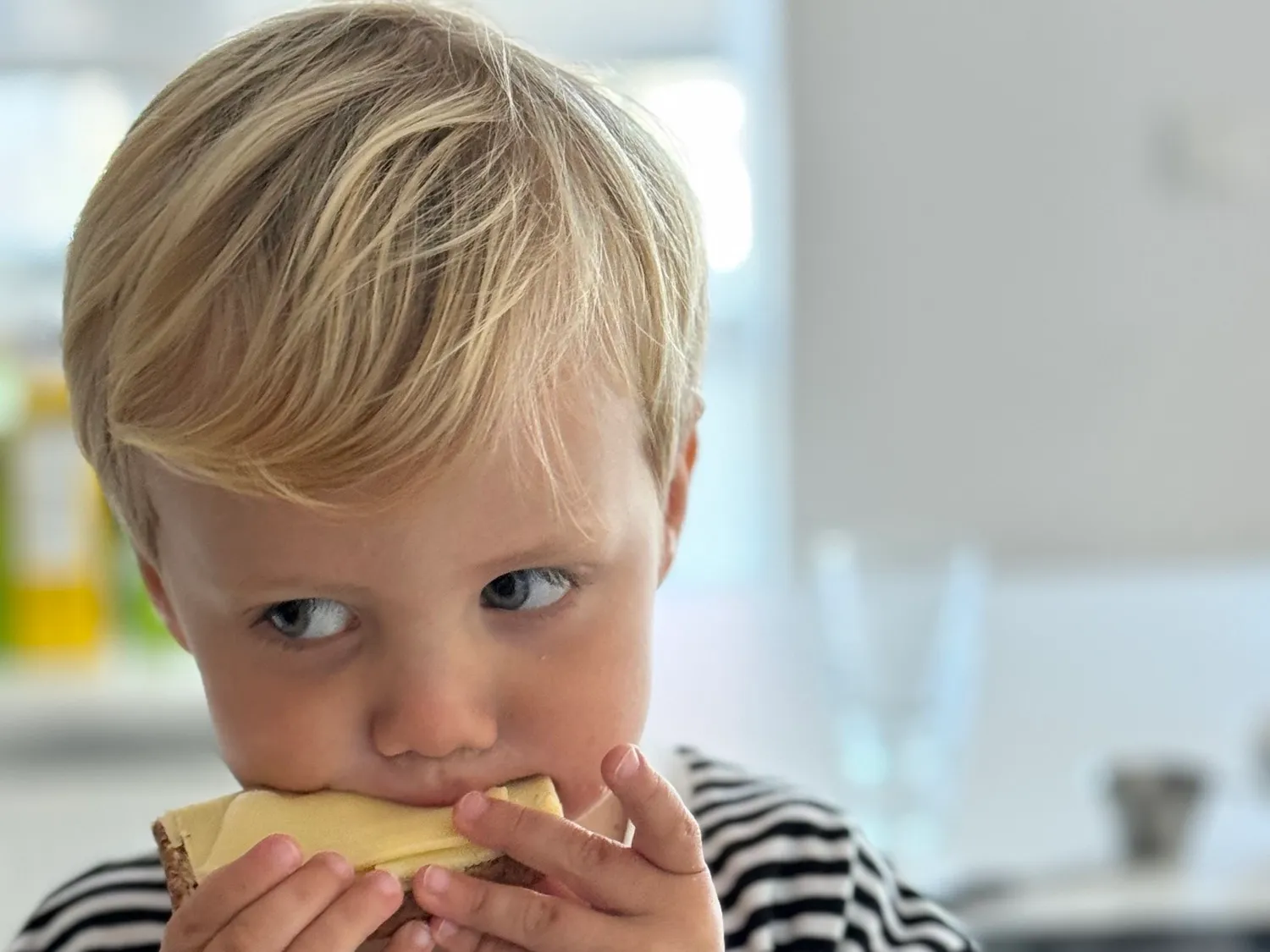
(Did I manage to get a photo of the child with a piece of broccoli in their mouth?? This one goes straight on Instagram–look, my child eats vegetables!)
Why mealtimes trigger us so much
I have negative memories from my childhood involving food and I know that a lot of you have them too.
As an example, I will never forget how I was once forced to drink milk in kindergarten. There was a blue speck of dust in my milk and I didn't want to drink it. The teacher probably didn't believe me, most likely assumed I was being disobedient and forced me to drink it. I threw up and have never had a glass of milk since.
In Respectful Parenting, we regularly ask ourselves what we wish to be the final goal for our children's behaviour. With regards to our children's food, what do we aim for? What is the "ultimate goal"? Don't we wish that our child develops a healthy relationship with food? That our child knows how to listen to its body? That food and meal times are enjoyable?
Can I make my child eat?
When it comes to setting limits, we distinguish between two types of behaviour. On the one hand we have the "non-negotiables" which we always set limits to. On the other hand, we have the "uncontrollables", the behaviours that we shouldn't try to control, and should avoid adding tension or conflict to. Food belongs to the latter category.
But why is food something we can't control?
Simply because one cannot force an individual to eat. In order to force an individual to eat food, some unpleasant circumstances are required. Another reason why food belongs to the latter category is that it's impossible to follow the limits set around a child's eating. We can't say "I'm not going to allow you....to not eat your food." How are we not going to allow that? How do we follow these limits through? The only way we can gain control over an uncontrollable situation is through manipulation. We put pressure, force, threaten, lie, make games, tell stories or play the "guilt-card"–asking our child to obey (in this case to eat their food) because otherwise we'll become sad, hurt or scared.
It's probably no surprise that these are methods we want to avoid in Respectful Parenting. Not only because they're unhelpful to build a child's healthy relationship with food, but also because these methods tend to have the opposite effect!
When a child feels pressured, or senses that we are trying to direct or control them, they're much more likely to express resistance. Children are sensitive, and they sense when we are trying to get them to do something.
"Mmmm... I loooove broccoli! It's my favorite food in the whole world! Don't you want to try it? Open your mouth, come on, om nom!"
But what can we do to get a child to eat?
The short answer is simply nothing. We should indeed stop trying to "get children to eat". If we focus on that and try to take responsibility for our children's food consumption, we'll quickly paint ourselves into a corner. A child should decide for themselves if they eat nothing, a little bit or a lot. However, this doesn't mean that we should indulge our children, let them do whatever they want and be solely responsible in terms of food and meal times. No.
But instead of trying to control if or what the child eats, we should start by focusing on controlling what we can control.
What to say when your child won't eat what's for dinner
First of all, we control what's for dinner. What's on the table is for dinner and nothing else. If the child doesn't want to eat anything that's on the dinner table, they can decide so. At the same time, we make sure there is always something on the table that everyone can eat. If the child asks for yoghurt, biscuits, porridge or a sandwich, we are ready with the same reply every time: we acknowledge the emotion, set the limits and keep them, no matter the reaction of the child.
"I hear that you want to have yoghurt, you don't want to have chicken at all!"
"You only want yoghurt, the strawberry yoghurt...ah yes, I know, you really like it."
"Yes, we do have strawberry yoghurt in the fridge, but we're not going to eat yoghurt right now, yoghurt is not what's for dinner."
"You absolutely don't want to eat the chicken tonight, I can hear that, it's ok."
"You don't have to eat the chicken if you don't want to, but there's nothing else for dinner than what's here on the table."
When your child plays with or throws food
In Respectful Parenting, we use natural consequences to follow the limits we want to set for our children. If a child is playing too much with its food, is spilling or throwing its food on the floor, we take it as a sign that the child has finished eating (and it's almost always the case). Then we can say something like:
"I see that you're putting the food into your glass, I'm not going to allow you to play with your food." “It seems like you are letting me know that you're finished eating", and then we move the child away from the table or take the food away.
The same thing applies when a child wants to leave the table. We can calmly remind them that if they choose to leave the table it means that the dinner time is over. If a child says that they have finished eating, we let them leave. Then, dinner time is over for the child and the food is removed from the table.
Through this approach, we can calmly but surely hold our limits around meal times. They're limits that will reduce the child's restlessness around the table and their desire to play with the food.
That being said, the limits we set must always come from ourselves and it's up to us to decide which (if any) limits we would like to set around meal times. Respectful Parenting encourages us to focus only on setting limits for things that we can control, and that the limits that we set can be easily followed.
How to bring in new mealtime limits
As is the case with all new rules and changes in our children's routine, it's always important to prepare a child for the changes to come. It helps them adjust to the new rules as well as helping ourselves to follow them through.
It's not fair to a child who's always been allowed to have a toast with cheese for dinner, no matter what's on the table, to suddenly experience a completely different routine, with new rules that have never been mentioned before. That is a recipe for conflict and strong objection.
Let the child know how things are about to change. Tell them that now we'll start a new rule around dinner; it's only allowed to eat what's on the dinner table. When we leave the table, it means that dinner time is over. If a child is playing a lot with the food, it's letting the parents know that it has finished eating.
We can tell them that we know it can be difficult when the rules change, and that it will take some time to adjust. We tell them we understand, and that we'll be there to help them if something becomes difficult.
In Respectful Parenting we always try to see ourselves as "on our children's side". We understand that they sometimes need time to practice and learn new rules. Therefore, it's good to keep in mind that we can, for example, offer the child to "try again" one more time when we are following the new rules. Then, we're ready to observe if/when they resume to playing with the food. If that happens, then the child has confirmed that it's finished eating, but sometimes they just need a second chance to try working within the new rules.
Snacks, praise, favourite foods and bedtime hunger
- Stress and tension during mealtimes can lead to more resistance, and result in the child eating less than it would in a relaxed and trusting atmosphere around food.
- If a child has little appetite during mealtimes, it's worth noticing whether they have been snacking on something too short a while ago.
- If a child consistently asks for the same food, the same cereal, the same yoghurt, and wants to have it for all meals, it can be a good idea to take a break from buying that product for a while. Breaking up the pattern is good once in a while.
- Don't praise a child for eating or encourage them to eat. Sometimes they eat more, sometimes less, just like we do. In the long run, it works well to be neutral around food. Our goal should be to avoid creating too many emotions related to food.
- If a child eats very little and then becomes hungry later on, it's good to have a rule that they can have one piece of fruit and a glass of water before bed. It's best if we always offer the same fruit (for example a banana) and that the fruit is not too exotic or exciting. This way, we can neutrally offer the child a little something and don't need to send them hungry to bed.
- This article assumes that the child is overall healthy and not dealing with any illnesses or physical problems that may interfere with their ability to eat. If concerns arise that the child may be experiencing malnutrition, it's important that parents seek medical and professional assistance.
Questions parents ask
Is it normal for a toddler not to eat dinner?
Yes. Sometimes they eat more, sometimes less, just like we do. If a child has little appetite at dinner, it's worth noticing whether they have been snacking a short while before.
Do I make something else if my child won't eat what's for dinner?
No. What's on the table is for dinner and nothing else. At the same time, we try to appeal to the whole family so that everyone can eat.
What if my child is hungry later?
It's good to have a rule that they can have one piece of fruit and a glass of water before bed, the same fruit every time, nothing too exotic or exciting. That way they don't go to bed hungry.
Is it OK to praise my child for eating?
It works well to be neutral around food. Praising a child for eating, or encouraging them to eat, creates more emotions around food, not fewer.
When is it time to worry about my child's eating?
If you are concerned that your child may not be getting enough to eat, or an illness or physical problem may be affecting their eating, seek medical and professional help.